

The Ocean Is Running a Fever — And the Great Barrier Reef Is Paying the Price
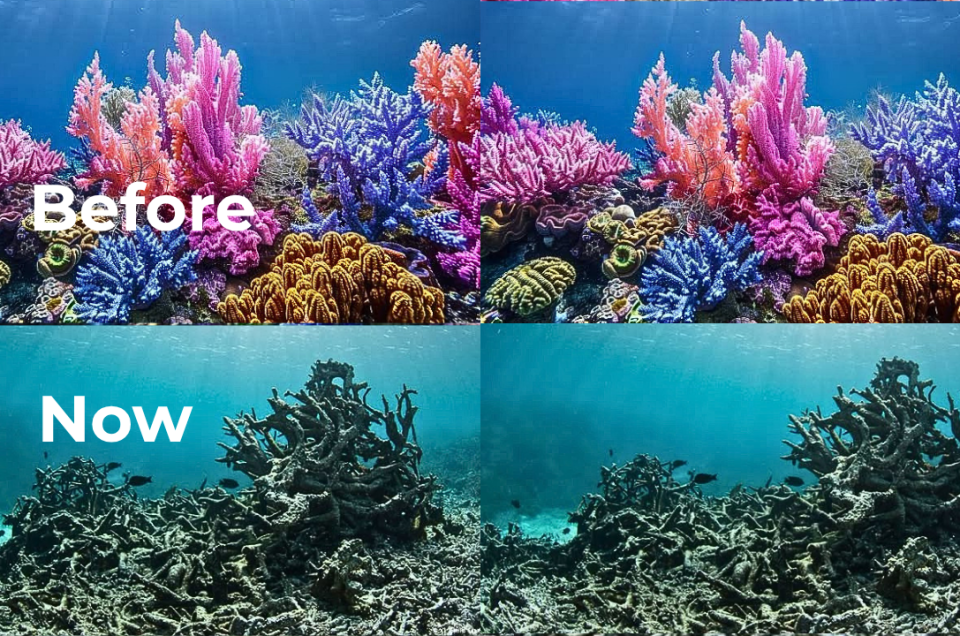
A honest look at the worst coral bleaching event ever recorded, what causes it, and whether the reef can ever truly recover.
By Ambassador Canon Chimenem Otto
When the Sea Becomes a Threat
There’s something deeply unsettling about an ocean that’s too warm. We tend to think of the sea as vast, cool, and indifferent, a force of nature that doesn’t bend to human pressure. But the Great Barrier Reef bleaching crisis of 2026 is showing us something different. The ocean is changing, and it’s changing fast enough that one of the most extraordinary living systems on Earth is struggling to keep up.
This summer, scientists monitoring the reef used words that stopped people mid-scroll: “like wildfires underwater.” That’s not a dramatic metaphor. It’s an accurate description of what thermal stress looks like when it spreads across a coral system the size of Italy. Patches of living colour, turning white silently and relentlessly. As someone who has spent years advocating for sustainability through CleanCyclers and hosting conversations about these exact crises, I can tell you this one hit differently.
What Coral Bleaching Actually Is — In Plain Terms
Coral bleaching causes a lot of confusion because the name sounds almost gentle. Like a cosmetic thing. It’s not. When ocean temperatures climb above the reef’s tolerance level, even by just one or two degrees, corals respond by expelling the microscopic algae living inside their tissue. Those algae, called zooxanthellae, are what give coral its vivid colour. More importantly, they’re what feed it, producing up to 90% of the coral’s energy through photosynthesis.
“When the algae leave, the coral turns ghostly white and starts to starve. It doesn’t die immediately — but if the heat continues, it will. And right now, the heat is continuing.” — Ambassador Canon Chimenem Otto,
If the temperatures drop quickly enough, the coral can recover and the algae can return. But if the heat stress continues for weeks or if the reef gets hit again before it’s had time to recover the coral dies and dead coral, as any marine biologist will tell you, is not a reef but a skeleton.
History of Coral Bleaching — And Why 2026 Is Different
The Great Barrier Reef has survived bleaching events before. In 1998, 2002, 2016, 2017, and 2020, significant portions of the reef bleached but each time, partial recovery was possible because cooler water eventually returned and gave the coral breathing room. Scientists described those events as warnings thou serious, but survivable.
What makes the Great Barrier Reef bleaching of 2026 different is the absence of that recovery window. Sections of the reef that showed early regrowth after 2020 are now white again. The reef isn’t just experiencing a bad year, it’s experiencing the cumulative effect of years of heat stress with no meaningful break. That’s a fundamentally different situation from anything we’ve seen before.
What’s Driving Ocean Temperatures This High
The honest answer is: us. Global greenhouse gas emissions trap heat in the atmosphere, and the ocean absorbs roughly 90% of that excess heat. Over time, that pushes baseline sea surface temperatures higher. El Niño events; natural warming cycles in the Pacific then sit on top of that already-elevated baseline and push temperatures into territory that reefs simply can’t handle.
“We keep treating the ocean like it has unlimited capacity to absorb our pollution. The reef is the clearest sign yet that it doesn’t.” — Ambassador Canon Chimenem Otto,
In 2026, scientists recorded sea surface temperatures around the reef that exceeded historical averages by alarming margins. And because the ocean takes a long time to release the heat it absorbs, even if emissions stopped tomorrow, some degree of continued warming is already locked in. That’s the difficult truth at the centre of every conversation about reef recovery.
“The reef can survive heat. What it can’t survive is heat with no end in sight and no time to rest.”
Why This Matters
It’s easy to think of the Great Barrier Reef as a tourist attraction, spectacular, yes, but distant. The reality is that coral reefs function as critical infrastructure for hundreds of millions of people around the world. They provide food, protect coastlines, support livelihoods, and anchor entire regional economies.
The Great Barrier Reef alone contributes over $6 billion AUD annually to Australia’s economy. Globally, coral reefs support an estimated 500 million people through fishing, tourism, and coastal protection, absorbing up to 97% of wave energy that would otherwise batter shorelines. When reefs die, fishing communities lose protein sources. Coastal towns lose natural flood barriers. The economic damage ripples outward in ways that take years to fully calculate.
The Science of Reef Recovery — What’s Actually Possible
Reef recovery is real. Coral can and does bounce back from bleaching events, given the right conditions. Scientists around the world are actively working to give it a better chance: breeding heat-resistant coral strains in labs, transplanting resilient fragments onto damaged sections, and improving local water quality to reduce the additional stress from pollution and agricultural runoff.
Australia has committed significant government funding to reef restoration programs, and the science is genuinely advancing. But every researcher working on this will tell you the same thing: local intervention only buys time, it doesn’t buy safety. Restoration can slow the decline. It cannot stop it if global ocean temperatures keep rising. The biology of reef recovery has limits, and those limits are defined by water temperature not human effort.
What Governments Are Actually Doing About It
Climate policy around reef protection sits in an uncomfortable tension. On one hand, Australia has invested heavily in the Reef 2050 Plan, channelling funding into water quality improvements, crown-of-thorns starfish control, and restoration science. On the other hand, the country continues to be one of the world’s largest coal exporters: a contradiction that marine scientists raise consistently and politely, and that politicians navigate carefully.
Internationally, the 2026 bleaching event has reignited pressure on governments to accelerate emissions cuts. Scientists are now making the explicit connection: the reef’s survival is a direct test of whether the climate commitments made in Paris and updated since then have any real-world effect. So far, the reef’s condition is not giving encouraging feedback.
What You Can Do That Actually Makes a Difference
Individual action on climate can feel meaningless when the scale of the problem is this large. And honestly, the reef’s fate isn’t going to be decided by reusable bags or shorter showers, it’s going to be decided by policy, by industry, and by the emissions trajectories of the world’s largest economies. That’s just the truth.
But that doesn’t mean individuals are powerless. Staying informed and sharing accurate information matters because public pressure shapes political will. Supporting organisations doing reef science and restoration matters. Voting for climate policy that reflects the urgency of what’s happening matters. And if you ever get the chance to see the reef in person, that matters too because people protect what they love, and it’s very hard not to love the reef once you’ve seen it.
The Reef Isn’t Gone Yet — But Time Will Tell
Here’s what Ambassador Canon Chimenem Otto wants you to take away: the reef is not dead. It is damaged, stressed, and running out of recovery time but it is still alive, and parts of it are still fighting. Restoration science is advancing faster than it was a decade ago. There is still a window, however narrow, where meaningful action changes the outcome.
The reef has been building itself for over 20,000 years. It has survived ice ages, sea level changes, and storms that would dwarf anything humans have seen. What it hasn’t faced before is sustained, human-driven warming with no natural end in sight. The question of whether it survives this isn’t a scientific question anymore. It’s a political one. And the answer depends entirely on what we decide to do next.
