Feeding the Future: Innovations for Food Security in a Changing Climate
By Amb. Canon Otto – Convener, Global Sustainability Summit | Founder, Cleancyclers
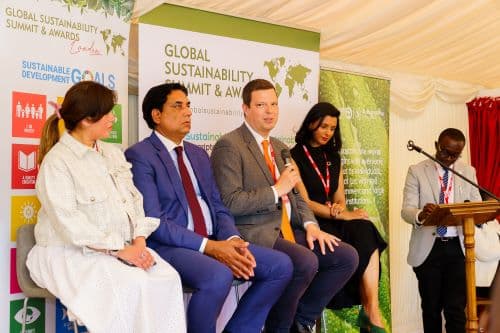
At the Global Sustainability Summit 2025, one issue stood out not just as a sectoral concern, but as a defining challenge of our time — food security in a changing climate.
The question before us is no longer whether we can produce enough food.
The real question is: can we produce food sustainably, equitably, and resiliently in a world shaped by climate uncertainty?
Through insights drawn from the Global Flagship Initiative for Food Security and expert panel discussions, it became clear that the future of food is not just about agriculture — it is about systems, innovation, and responsibility.
A Climate Reality We Can No Longer Ignore
Across continents, farmers are facing:
- Unpredictable rainfall patterns
- Prolonged droughts and extreme flooding
- Soil degradation and biodiversity loss
- Rising costs of production and distribution
These are not isolated disruptions — they are signals of a system under pressure.
As Canon Otto, I have always emphasized that sustainability must begin where life begins — and that is food. If we fail to secure our food systems, every other sustainability goal becomes fragile.
Rethinking Agriculture: From Survival to Sustainability
At the Global Sustainability Summit, we explored a necessary shift:
From traditional agriculture
➡ to climate-smart, regenerative, and technology-enabled systems
Key innovations highlighted include:
1. Climate-Smart Agriculture
Farmers are adopting practices that improve resilience — drought-resistant crops, precision irrigation, and soil regeneration techniques that restore fertility while reducing emissions.
2. Digital Agriculture & Data-Driven Farming
Technology is transforming how food is grown. From satellite monitoring to AI-powered crop management, farmers can now make smarter, faster, and more sustainable decisions.
3. Sustainable Financing for Agriculture
Access to capital remains a major barrier. Responsible financing models — a recurring theme at the Summit — are essential to empower farmers, especially in developing regions, to scale sustainable practices.
4. Circular Food Systems
Reducing food waste, repurposing agricultural by-products, and integrating circular economy principles are critical to building efficient and sustainable food value chains.
Cleancyclers: Connecting Circularity to Food Systems
At Cleancyclers, we understand that sustainability is interconnected. Waste management, energy use, and agriculture are part of the same ecosystem.
Through circular economy initiatives, Cleancyclers contributes to food system sustainability by:
- Promoting organic waste recycling into compost and bio-resources
- Supporting local agricultural resilience through resource recovery
- Reducing environmental pollution that impacts soil and water systems
This is where circular economy meets food security — turning waste into value and supporting regenerative agriculture.
SustainabilityUnscripted: Amplifying the Human Story Behind Food Systems
While policies and technologies are essential, we must not forget the human dimension.
Through SustainabilityUnscripted, we continue to highlight the lived realities of farmers, communities, and food producers — ensuring that global conversations remain grounded in real experiences.
Because food security is not just about supply chains.
It is about people, livelihoods, and dignity.
The Role of Partnerships: From Local Farms to Global Impact
No single actor can solve food insecurity.
At the Global Sustainability Summit, one message was clear:
collaboration is the foundation of resilient food systems.
We must strengthen:
- Public-private partnerships
- Cross-border agricultural cooperation
- Knowledge sharing between developed and developing economies
- Community-led solutions supported by global frameworks
This is how local innovation becomes global impact.
A Canon Otto Call to Action
As I reflect on the discussions at the Summit, one truth stands firm:
Feeding the future is not optional — it is urgent.
We must:
- Invest in sustainable agriculture
- Empower farmers with knowledge and resources
- Integrate circular economy principles into food systems
- Build partnerships that prioritize long-term resilience over short-term gain
Through the Global Sustainability Summit, Cleancyclers, and SustainabilityUnscripted, we remain committed to advancing solutions that ensure no one is left behind in the journey toward food security.
The Future of Food Is the Future of Humanity
If we get food systems right, we unlock progress across:
- Health
- Economy
- Climate action
- Social stability
If we get it wrong, everything else is at risk.
The future is not something we wait for.
It is something we cultivate — just like the land we depend on.
And together, we must ensure that what we cultivate today can feed tomorrow.