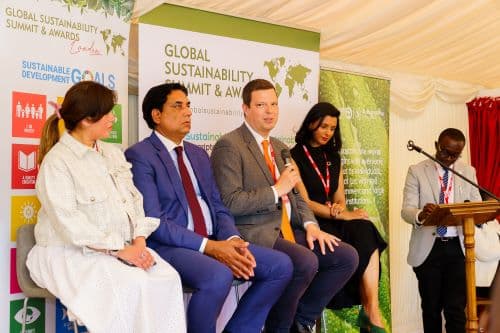
From 2025 to 2026: How the Global Sustainability Summit Is Evolving

By Amb. Canon Otto – Convener, Global Sustainability Summit | Founder, Cleancyclers
The Global Sustainability Summit has never been about moments.
It has always been about movement.
As we transition from 2025 to 2026, one thing is clear:
we are not simply planning another Summit — we are evolving a global platform for action, accountability, and accelerated impact.
At Canon Otto, I see this evolution not as optional, but necessary. Because the challenges we face as a global community are intensifying, and our response must evolve accordingly.
Lessons from 2025: What the Summit Taught Us
The 2025 Global Sustainability Summit reaffirmed a powerful truth:
the world is ready for change — but change must be structured, financed, and sustained.
Several key lessons emerged:
1. Conversations Are No Longer Enough
Stakeholders across sectors made it clear — dialogue must now translate into implementation. The era of awareness has passed; we are now in the era of execution.
2. Collaboration Is the New Currency
No single institution, government, or organization can solve sustainability challenges alone. The most impactful outcomes in 2025 came from cross-sector partnerships.
3. Inclusion Drives Impact
From youth voices to women leaders and grassroots innovators, it became evident that inclusive participation strengthens sustainable solutions.
4. Accountability Must Be Visible
Commitments made on stage must be tracked beyond the Summit. This is where platforms like SustainabilityUnscripted continue to play a critical role — ensuring that conversations are documented, analyzed, and followed through.
The Shift to 2026: From Dialogue to Acceleration
If 2025 was about alignment, then 2026 will be about acceleration.
The Global Sustainability Summit 2026 is being designed with a sharper focus:
- Faster execution of sustainability initiatives
- Stronger accountability frameworks
- Scalable solutions across regions and sectors
At Cleancyclers, we understand that sustainability must operate at the intersection of innovation and practicality. This philosophy will shape the 2026 agenda — ensuring that solutions discussed are not only visionary, but implementable and measurable.
New Priorities for 2026
The evolution of the Summit is reflected in its expanded priorities:
1. Scaling Circular Economy Solutions
Through Cleancyclers, we have seen how circular systems can transform waste into opportunity. In 2026, the focus will shift to scaling these solutions globally, particularly in emerging economies.
2. Financing Sustainability at Scale
Responsible financing will move from discussion to deployment:
- ESG investments with measurable outcomes
- Increased access to climate finance
- Stronger public-private partnerships
3. Climate Resilience and Adaptation
Beyond mitigation, the Summit will prioritize:
- Community resilience
- Infrastructure adaptation
- Nature-based solutions
4. Technology as an Enabler
Innovation will play a central role, including:
- AI-driven sustainability solutions
- Data for decision-making
- Smart, sustainable urban systems
5. Human-Centered Sustainability
Sustainability must remain rooted in people. This includes:
- Youth leadership
- Gender inclusion
- Community-driven solutions
Through SustainabilityUnscripted, these priorities will be continuously explored, ensuring that global narratives remain grounded in real-world impact.
Expanding Global Reach and Partnerships
The Global Sustainability Summit 2026 will significantly expand its global footprint.
We are seeing increased engagement from:
- Governments and policymakers across regions
- Private sector leaders and investors
- International development organizations
- Grassroots innovators and community leaders
These partnerships are not symbolic — they are strategic.
As Canon Otto, I believe that peaceful and purpose-driven partnerships are the backbone of sustainable development. When aligned correctly, they unlock:
- Resources
- Expertise
- Scalable impact
From Event to Ecosystem
One of the most important evolutions of the Global Sustainability Summit is this:
We are no longer just hosting an event.
We are building an ecosystem.
An ecosystem where:
- Ideas are generated
- Partnerships are formed
- Solutions are tested
- Impact is tracked
Through Cleancyclers, sustainability is practiced.
Through SustainabilityUnscripted, sustainability is communicated.
Through the Global Sustainability Summit, sustainability is convened and accelerated.
Together, they form a continuous cycle of action, reflection, and growth.
Canon Otto’s Vision for the Future
As we look toward 2026, my vision as Canon Otto is clear:
To position the Global Sustainability Summit as:
- A global benchmark for sustainability leadership
- A platform for measurable impact
- A catalyst for transformative partnerships
We must move beyond incremental change.
We must pursue systemic transformation.
A Collective Responsibility
The evolution of the Summit reflects a broader truth:
Sustainability is no longer a choice — it is a shared responsibility.
To every stakeholder reading this:
- Governments must lead with policy and accountability
- Businesses must align profit with purpose
- Communities must be empowered to act
- Individuals must adopt sustainable practices
The Journey Continues
From 2025 to 2026, the Global Sustainability Summit is not slowing down —
it is scaling up.
The journey ahead demands courage, collaboration, and commitment.
But it also offers an opportunity to redefine our future.
And through Cleancyclers, SustainabilityUnscripted, and the leadership of Canon Otto, we remain committed to ensuring that this evolution delivers real, lasting impact.